Is your ESG architecture ready for EBA Supervisory Reporting?
6-minute read
Published on: 24 September 2026
What if you had roughly two weeks to turn fragmented ESG data into validated, report-ready supervisory information?
The European Banking Authority (EBA) is introducing its first ESG supervisory reporting. The revised requirements will bring more granular information, stronger integration with other supervisory data, and greater consistency across reporting. The EBA plans to finalize the revised Implementing Technical Standards (ITS) by the end of 2026, with the first reporting under the revised framework currently expected for the reference date of September 30 2027.
For many banks, ESG reporting has evolved incrementally. New requirements have led to new data sources, new calculations, new tools, and, in many cases, new workarounds. The new supervisory framework adds further granularity and brings ESG reporting closer to the wider prudential reporting landscape. As a result, banks need to bring together more information and processes within a much tighter reporting window.
Processes that once took months may soon need to be completed in roughly two weeks. That means sourcing and calculating ESG data, validating it, and preparing the final results — all within a much tighter window.
In that environment, manual and semi-manual processes quickly become a bottleneck. Banks need to produce trusted ESG information faster, more consistently and with greater transparency across the reporting value chain.
The question is therefore no longer: How can we report the next ESG KPI?
It is: Is your ESG architecture ready to operationalize supervisory reporting?
EBA is raising the bar with its new ESG supervisory reporting requirements.
The EBA’s draft revisions to the ITS on supervisory reporting mark an important step in integrating ESG risks more firmly into the prudential reporting framework. The objective is not simply to add more ESG data points. It is to make reporting formats, frequencies, and instructions more uniform. This will give supervisors a more consistent and granular view of ESG risks. The proposed ESG reporting framework builds on the existing Pillar 3 ESG disclosure framework while introducing additional information for supervisory purposes within their reporting templates named D01-D11 and streamlining both reporting requirements.
Several developments are particularly relevant for banks across the proposed D01–D11 templates
- Nature-related risks enter supervisory reporting: The framework goes beyond climate-related risks The proposed D11.00 introduces environmental risks beyond climate. It covers physical and transition risks related to areas such as biodiversity loss, ecosystem degradation, pollution, and the overexploitation of natural resources. For banks, this means ESG reporting needs to extend beyond climate and capture these additional environmental risk drivers.
- Greater exposure granularity: The new D04.00 template introduces environment-related concentration risk and requires reporting on counterparties where total exposure exceeds the proposed EUR 10 million threshold. For banks, this means linking environmental risk information to individual counterparties and their exposures, rather than relying only on aggregated portfolio-level assessments.
- More detailed climate-risk information: Existing templates covering transition risk, physical risk, emissions, energy performance and mitigating actions remain an important part of the framework. For large institutions, several of these templates are proposed at semiannual reporting, while others remain annual, increasing the need for repeatable processes rather than one-off reporting exercises.
- Closer integration with prudential risk information: ESG reporting is also becoming more closely integrated with the wider prudential framework, including credit-risk information and stress testing. In other words, ESG reporting can no longer be treated as a standalone exercise. It needs to work with the bank’s existing risk and regulatory reporting processes. For banks, this means ESG data and calculations need to connect with existing risk and regulatory reporting processes, with aligned definitions, controls and traceability across the reporting landscape.
The challenge is therefore not simply more ESG reporting. Banks need to turn increasingly granular ESG data into supervisory information — faster, transparently, and with full traceability.
ESG is not a reporting problem. It is a value chain problem.
Most ESG solutions and spreadsheets were not designed for supervisory reporting. They were introduced to address specific business or regulatory needs: calculating financed emissions, sourcing sustainability data, supporting disclosures, or addressing individual climate-risk requirements. As requirements evolved, banks typically added new tools and data sources around their existing architecture.
The result is often a landscape that works well for individual use cases, but is difficult to operate as one reporting process. Customer and counterparty data may sit in core banking or lending systems. Finance and Risk platforms provide exposure and financial data. External providers supply emissions and other ESG attributes. Specialist ESG applications and spreadsheets perform individual calculations. Manual processes then fill the gaps, reconcile results, and prepare the final reporting outputs.
Each component may serve a valid purpose. The challenge is what happens between them.
Data needs to move between systems. Different tools may apply different calculation logic or use different versions of the same data. Exceptions may need to be handled manually. And when a reported KPI is challenged, the bank needs to be able to trace it back to its source data, methodology, and calculation.
This becomes even harder when reporting needs to be produced within a much tighter window. With roughly two weeks to work, there is little room to repeatedly extract data, recalculate KPIs, reconcile results, and resolve inconsistencies across systems.
The consequences are familiar:
- inconsistent results across reports
- repeated data extraction and transformation
- manual reconciliation
- duplicated calculation logic
- limited data lineage and transparency
The underlying issue is that ESG architecture has largely evolved around individual reporting, risk and business requirements rather than around a connected ESG foundation that can serve all functions from a common foundation. As reporting becomes more granular and timelines tighten, repeatedly assembling the same information for each reporting cycle becomes increasingly difficult to scale.
The ESG supervisory reporting value chain
In order to meet the new supervisory reporting requirements, banks need more than just a reporting tool. They need an ESG architecture that can turn relevant source data into reliable ESG intelligence and make it available across the bank – from risk and finance to reporting and submission.
Source and Data Foundation → ESG Intelligence → Reporting and Submission
Source and Data Foundation brings together relevant internal and external information and creates a standardized, quality-controlled basis for ESG reporting.
ESG Intelligence turns this foundation into reusable KPIs using defined methodologies, automated calculations, and embedded controls.
Reporting and Submission takes these results into aggregation, regulatory reporting, and submission. It also links ESG information to the wider prudential reporting landscape.
The objective is not simply to automate individual ESG reporting. It is to establish an integrated process in which data, methodologies, controls and reporting outputs remain linked from source to submission and can be reused for other regulatory, risk, or business use cases.
SAP Fioneer: Connecting the ESG reporting value chain
This is the approach SAP Fioneer brings to ESG supervisory reporting: an end-to-end, modular architecture linking data, ESG intelligence and reporting processes. At the center of this approach is the Fioneer ESG KPI Engine. It transforms the bank’s data foundation into reusable KPIs and insights. The engine supports the calculation of key environmental risk and exposure information reflected in the EBA’s proposed ESG reporting framework, including transition risk, physical risk, emissions and environmental risks beyond climate. Together, these capabilities help banks prepare and validate ESG information within the two-week reporting window.
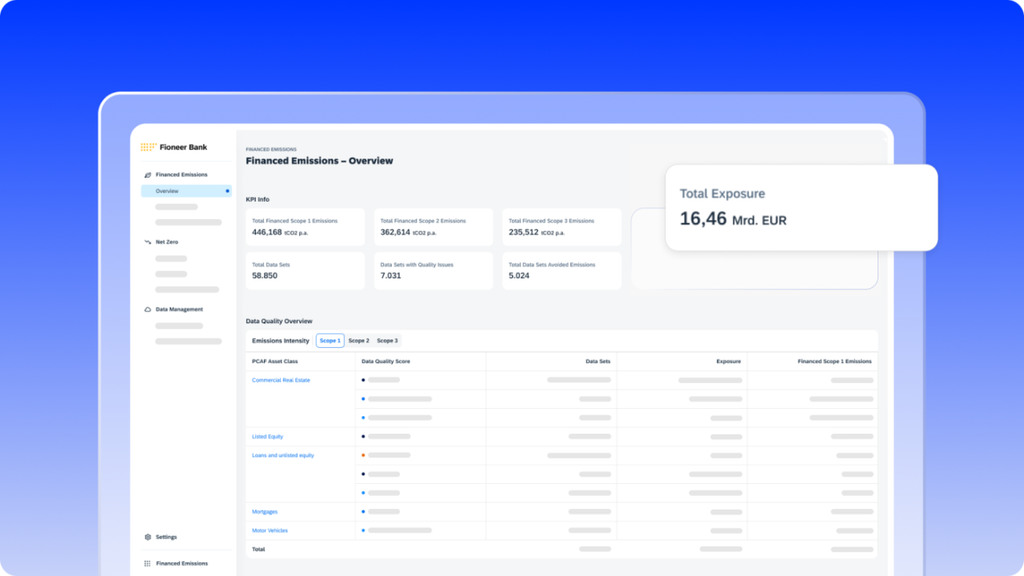
Configure. Calculate. Control.
Configure. The ESG KPI Engine combines extensive preconfigured ESG logic with the flexibility to adapt the solution to bank-specific requirements. Relevant KPIs, methodologies, and calculation logic are available as standard and updated to reflect regulatory developments. Banks can also configure parameters, data sources, and other settings where needed. This enables banks to leverage standardized software and up-to-date regulatory logic without building custom calculations for every new requirement.
Calculate. Once the relevant data and logic are configured, the ESG KPI Engine automates the calculation of ESG KPIs, transforming granular information into validated results and portfolio-level views. This reduces the need for repeated spreadsheet work and manual calculation models, helping banks work within a much tighter reporting window.
Control. Calculation alone does not create trusted ESG intelligence. Banks need to understand where a result came from, which data was used, which logic was applied and how exceptions were handled. The ESG KPI Engine embeds validation, transparency, traceability and auditability throughout the process.
The result is trusted ESG insights that can be understood, validated and reused across the bank.
The ESG KPI Engine connects to relevant internal and external data sources and makes ESG data and results available to downstream processes. For banks using SAP Fioneer’s broader bank management platform, it can additionally leverage FSDM and the shared data foundation across Finance, Risk and Regulatory Reporting.
The real deadline is architectural readiness
The direction is clear: ESG information is becoming an increasingly important part of prudential supervision.
The goal is not simply to report faster. Banks need an ESG reporting value chain that can keep up with changing requirements, while maintaining transparency, traceability, and the right controls.
With the ESG KPI Engine at its core, SAP Fioneer links the data foundation with ESG intelligence and the wider reporting process. Banks can use the ESG KPI Engine within their existing architecture or as part of a broader Finance, Risk, and Regulatory Reporting transformation.
The revised framework is currently expected to be effective by the September 30 2027. That may seem some way off, but preparing the data, processes, and architecture takes time.
So, is your ESG architecture ready for EBA supervisory reporting?
Now is the time to assess your current setup and prepare for what is coming next.
Talk to SAP Fioneer about building a connected, scalable and controlled ESG reporting architecture.

Most read posts

What sets modern policy administration systems apart

The risk of staying stagnant: How corporate banks are stepping up in cash management with virtual account solutions

Virtual account management: the quick win for a stronger cash management proposition
More posts
Get up to speed with the latest insights and find the information you need to help you succeed.