Liquidity moves in seconds. Can your bank respond in real time?
6-minute read
Published on: 2 October 2026
The value add and consequences of real time liquidity management has become both apparent and critical for banks. For decades, banks have managed liquidity, including short term and what is now called intraday liquidity through reporting cycles, historical trend analysis and periodic/static stress testing. These approaches remain important, but they were built for a world in which liquidity pressures often developed over months and weeks, not days or intraday.
That assumption has failed and caused banks to scramble.
Modern payment infrastructure, digital banking channels and changing customer behavior allow liquidity to move through the financial system at unprecedented speed. What was once a gradual trend can now become an immediate challenge. Deposits are not so sticky and assumptions can change (both from a Treasurer as well as a Depositor perspective).
A surge in payments, a concentration of outflows or an unexpected change in customer behavior can alter a bank’s funding position before its next scheduled report is available.
As a result, liquidity management is no longer simply a reporting exercise. It’s becoming an operational capability based on timely insight, effective governance and informed decisions.
We discussed this with EY during an industry briefing. The themes that came from this briefing point to a clear shift from monitoring and reporting toward decision driven forecasting, decision support an very active management.
This doesn’t make established controls less important. End-of-day and regulatory views still matter. Teams are still managing to ‘get to end of day’. But teams also need to understand how positions are changing during the day, what is driving those changes and which actions are available when unexpected activity moves away from plan.
The liquidity cycle is shrinking
Recent banking stress events have shown how quickly confidence can change and funding positions can deteriorate. Assumptions about customer behavior, deposit stability and access to funding can become less reliable when market conditions shift.
Intraday volatility and faster payment activity also mean that funding pressures can emerge over hours or days rather than weeks. This shortens the time available to understand events and respond. Speed isn’t the only challenge, though. Liquidity Management may be spread across payment systems, treasury platforms, core banking applications, collateral systems and spreadsheets.
Even when the data is available, bringing it together into a consistent view can take too long. By the time teams have reconciled the position, it may already have changed.
This creates a practical management gap. Leaders may know that liquidity is moving without having a trusted view of:
- Why it’s moving
- Whether the change is temporary or structural
- Which response could have
Regulators, boards and executive teams are paying closer attention. The focus is moving beyond understanding liquidity risk toward demonstrating that the bank can respond within minutes when conditions change.
The question is no longer: “Can we monitor liquidity?”
It’s becoming: “Can we identify emerging pressure early enough to act?”
Why retrospective reporting isn’t enough
Traditional reporting remains essential for control, oversight and regulatory processes. However, a snapshot may not show risk developing during the business day or explain how quickly a position is moving away from expectations.
Treasury and liquidity teams need timely visibility into:
- Intraday payment flows
- Funding movements
- Collateral utilization
- Available balances
- Deviations from expected activity
Without this insight, teams may base decisions on information that is already out of date. They can also spend valuable time collecting and reconciling data instead of assessing the situation and preparing a response.
Visibility alone isn’t the objective. Information must support action.
A current balance becomes more useful when teams can compare it with the expected position, understand the cause of any variance, assess its likely direction, and decide whether they need to intervene.
That requires a connected view. Payment activity, available funding, collateral capacity, forecasts, and internal limits need to be considered together. This allows decision-makers to understand both the immediate position and the options available to them.
What real-time readiness means
Real-time readiness doesn’t mean reacting to every fluctuation. It means giving Treasury, Liquidity, Operations and Risk teams the information, context, and governance they need to distinguish normal variations from a developing issue.
A practical operating model connects four elements:
- Trusted data that brings together relevant balances, flows, forecasts, collateral and funding information
- Context that shows whether movements are expected, unusual, concentrated or connected to a broader scenario
- Decision support that helps teams assess options, dependencies and potential consequences
- Governance that defines thresholds, escalation paths, responsibilities and approval authority
When these elements work together, real-time management isn’t about producing more dashboards. It’s about shortening the distance between a signal and a well-governed decision.
Moving from monitoring to management
The next stage of liquidity maturity is intraday liquidity management: a repeatable cycle of observation, interpretation, decision, and follow-through.
Active management combines:
- Timely liquidity visibility
- Forecasting
- Automated alerts
- Clear governance
- Decision support
Together, these capabilities can help institutions identify potential pressure earlier, assess its impact, and make funding or collateral decisions with greater confidence.
The focus shifts from observing what has happened to understanding what may happen next and determining the appropriate response.
A more active operating cycle can help teams:
- Detect deviations before they become larger operational issues
- Explore scenarios and understand how changing assumptions may affect future positions
- Prioritize alerts so attention goes to meaningful changes rather than routine volatility
- Coordinate treasury, risk, finance, operations and business stakeholders around a common view
- Document decisions and escalation steps to support transparency and accountability
- Smooth liquidity flows and eliminate peaks and troughs
- Ensure consistency and predictability thus reducing crisis management and ensuring that stakeholders remain in BAU mode.
Technology is an important enabler, but the operating model matters just as much. Faster information has limited value when ownership is unclear or approvals can’t keep pace.
Banks therefore need to align data, processes, roles, controls, and technology around the decisions that teams may need to make as conditions change.
Five questions for liquidity leaders
Banks can start by asking five practical questions:
- How current is our liquidity view when market or customer behavior changes?
- Can we explain a material variance without a lengthy manual reconciliation?
- Do our forecasts update quickly enough to support intraday decisions?
- Are alerts connected to clear thresholds, owners and escalation paths?
- Can decision-makers assess funding and collateral options using consistent information?
A gap in any one area can slow the overall response.
The goal isn’t to transform every process at once. It’s to identify the decisions where timing matters most, connect the information required for those decisions, and establish a clear path from insight to action.
The path forward
Institutions that combine trusted information, forward-looking insight, and effective governance will be better equipped to respond to changing conditions. They can also create a more resilient operating model in which teams spend less time assembling the picture and more time deciding what it means.
Liquidity management is no longer only about visibility. It’s about recognizing change, understanding its implications, and responding with speed and control.
It’s about turning learning time into action.
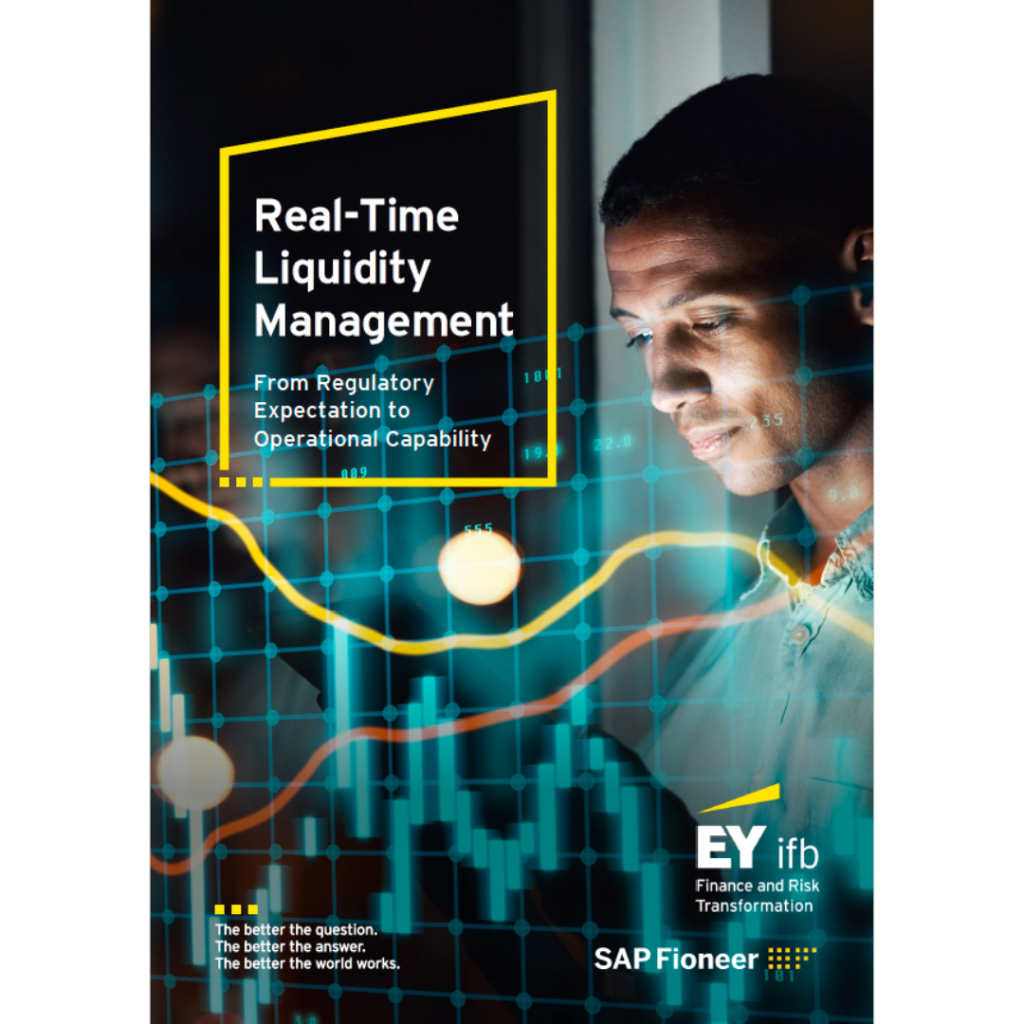
Download the whitepaper
Download the joint SAP Fioneer and EY whitepaper, Real-Time Liquidity Management: From Regulatory Expectation to Operational Capability, and explore how leading institutions are moving from visibility to action in liquidity management.

Related posts

Five capabilities of a modern accounting subledger

The next phase of financial services: Moving beyond standalone agents to trusted, agentic finance execution

The subledger problem behind messy finance data
Most read posts

What sets modern policy administration systems apart

The risk of staying stagnant: How corporate banks are stepping up in cash management with virtual account solutions

Virtual account management: the quick win for a stronger cash management proposition
More posts
Get up to speed with the latest insights and find the information you need to help you succeed.