Why banks need a platform-led approach to unlock business value
8-minute read
Published on: 27 August 2026
Few banking executives question the need for finance modernization. The greater challenge is ensuring modernization delivery measurable business value while creating a finance function that can continuously adapt to future change.
The business imperative is clear: finance functions need to become more efficient, transparent and adaptable in an environment of constant regulatory and business change. We see the symptoms every day:
- Fragmented systems
- Manual reconciliations
- Specialist dependency
- Slow reporting cycles
- Limited transparency across finance and risk
- And the rising cost of every new regulatory or business change
The harder question is not whether to modernize. It’s how to modernize without creating another multi-year transformation program that is expensive, disruptive and difficult to control.
McKinsey research suggests that roughly 70% of large-scale transformations fail to achieve their objectives. For banking executives, the challenge is not recognizing the need to change. It is finding an approach that delivery value without repeating the cycle of cost overruns, delays and complexity that has characterized so many transformation efforts.
For many banks, this is the real modernization dilemma. The ambition and business need are clear. But memories of long design phases, complex integrations, repeated validation cycles and uncertain time-to-value still create hesitation.
And the opportunity has become even greater with AI. Organizations with a modern finance foundation are better positioned to unlock productivity gains, improve decision-making and accelerate the value delivered through AI.
In this article, we explore how banks can build a modernization strategy that delivery measurable business value, strengthens control and creates a foundation for continuous finance evolution while avoiding past mistakes.
With the need to be AI-ready, delaying finance transformation is no longer an option
Banks are under growing pressure to demonstrate tangible productivity gains from AI, increasing the urgency of finance modernization.
Many banks are exploring AI use cases across forecasting, close, reconciliations, reporting, controls, analytics and management steering. However, AI is only as effective as the finance foundation beneath it. Trusted data, strong controls, traceability and business context are prerequisites for applying AI safely and effectively in finance.
KPMG’s 2026 research shows AI adoption in finance increased from 30% to 75% since 2024. Yet only 42% of organizations are assurance-ready, with those organizations achieving 3-6x better outcomes.
This is where a Finance Management Platform (FMP) becomes critical, providing the governed finance foundation required to scale AI effectively.
Banks that delay finance transformation risk falling behind both in operational efficiency and their ability to scale AI-driven innovation.
This leads us to the key question:
How can you build a finance modernization program that creates a self-adaptive finance function?
To build an AI-ready finance platform and create lasting business value, you need to consider three things:
- What drives successful modernization?
- What would a better modernization approach look like?
- How can you achieve a self-adaptive finance function?
A self-adaptive finance function is the one that absorb regulatory, business, product and reporting changes faster and with stronger control and significantly lower marginal cost. This should be the ultimate objective of modernization.
Let’s take a look at each of these three questions in turn:
1. Five principles that drive finance modernization success
Based on our experience across finance and subledger transformations, successful modernization programs consistently follow a number of common principles:
- Keep business value visible: Leading modernization programs translate strategic objectives into measurable outcomes and use them to steer decisions throughout delivery. Value realization should be tracked from day one, not just measured after go-live.
- Deliver value incrementally: Modernization should be structured to deliver measurable outcomes in stages, building momentum, reducing risk and accelerating time-to-value. It’s wrong to believe that benefits will only materialize once the target architecture is fully implemented.
- Simplify end-to-end processes and architecture: Simplifying the ledger alone doesn’t simplify finance. A modern finance platform should reduce reconciliation effort, improve transparency and strengthen date lineage across the finance value chain.
- Standardize intelligently: Organizations create the greatest long-term value when they adopt modern, proven standard capabilities and industry best practices wherever possible, challenging legacy processes only where they no longer support strategic business outcomes.
- Protect platform core and maximize standard capabilities: Perhaps the most common lesson is the cost of excessive customization. Our experience shows that at least 85% of requirements can often be covered through pure standard capabilities, yet many programs achieve only 50-60% standardization because they continue to adapt the platform to legacy ways of working. The result is that 40-50% of custom developments can consume more than 90% of the implementation budget, driving cost, risk and delays.
Taken together, these principles point to a common theme:
Successful modernization is not about replacing technology alone. It’s about delivering value early, simplifying architecture and processes and creating a finance foundation that can absorb future change at a lower cost.
2. What finance modernization looks like when built for long-term value
A platform-led approach starts with a different question:
What finance architecture will allow the bank to absorb future change faster, safer and at a lower marginal cost?
That question changes the transformation logic. Instead of optimizing individual applications, the focus shifts to establishing a shared backbone of finance data, traceability, integrated controls, consistent reporting and extensibility. Here, the process moves to the data and not the other way around.
The answer is a Finance Management Platform (FMP). An FMP provides a common operating foundation that supports finance, risk, treasury, risk, treasury, liquidity, capital and regulatory processes.
So, how can banks make this vision a reality?
Building a self-adaptive finance function requires more than technology replacement. It requires a modernization approach built on four proven success factors:
- Start with a data-first platform vision. Finance architecture should be organized around governed data, controls and business outcomes rather than individual application deployments. Granular, traceable, position-level data provides the foundation for reporting, compliance and future AI-enabled use cases.
- It should be business-led, not system-led. The objective is to improve the bank’s ability to close, report, steer, comply and adapt. This requires finance, risk, regulatory and audit teams to align on a shared target architecture and roadmap.
- Controls should be treated as a strategic asset rather than a compliance afterthought. Auditability, lineage, reconciliation and validation need to be designed into the end-to-end process.
- The delivery model itself must evolve. Transformation should deliver value incrementally through an AI-enabled, continuously validated approach supported by strong governance, reusable capabilities and measurable outcomes.
3. From one-off transformation to a self-adaptive finance function
The banks that succeed will be those that continuously reduce the effort and cost of future change.
That’s the real prize of platform-led finance modernization with a self-adaptive finance function.
In such a model, new regulatory requirements, reporting needs, product launches and business changes can be absorbed with minimal disruption. AI-enabled processes can scale more easily and anticipate change because they are built on a transparent data foundation, integrated controls and explainable process logic.
Achieving long-term modernization value requires a different mindset. It means moving from fragmented systems to an integrated platform. It also means measuring success not only by go-live, but by the bank’s future ability to generate business value and to adapt to change efficiently. Those that delay risk increasing technical debt, limiting AI adoption and making future transformation more expensive.
Using AI to enable the self-adaptive finance function
AI is accelerating the value that can be achieved from a modern, governed finance platform. This opportunity requires appropriate governance and expert oversight. AI does not remove the need for finance, accounting, risk and architecture expertise, but it can reduce friction in transformation delivery.
For example, AI can help uncover requirements embedded in legacy systems, spreadsheets and undocumented processes that are no longer fully understood within the organization.
It can also turn verbal and unstructured business inputs into structured requirements, support mapping activities, generate test scenarios and validate assumptions earlier in the delivery cycle.
The benefit is not autonomous transformation but enabling expert teams to spend less time extracting information and more time creating value.
More importantly, AI can help create a self-adaptive finance function. When built on trusted data, integrated controls and explainable process logic, AI makes it easier to anticipate and absorb new business, regulatory and reporting requirements without repeatedly increasing complexity.
Unlocking business value through platform-led finance modernization
The objective of finance modernization is not technology replacement. It’s creating measurable business value while reducing the cost of future change.
For CFOs and COOs, that means better decision-making, stronger controls, improved transparency, faster regulatory response and a finance function that can continuously adapt to new business and regulatory requirements.
A Finance Management Platform (FMP) provides the foundation for this by connecting data, controls, reporting and decision-making across the enterprise. The result is a self-adaptive finance function that is simple to operate, easier to evolve and better positioned to unlock the value of AI.
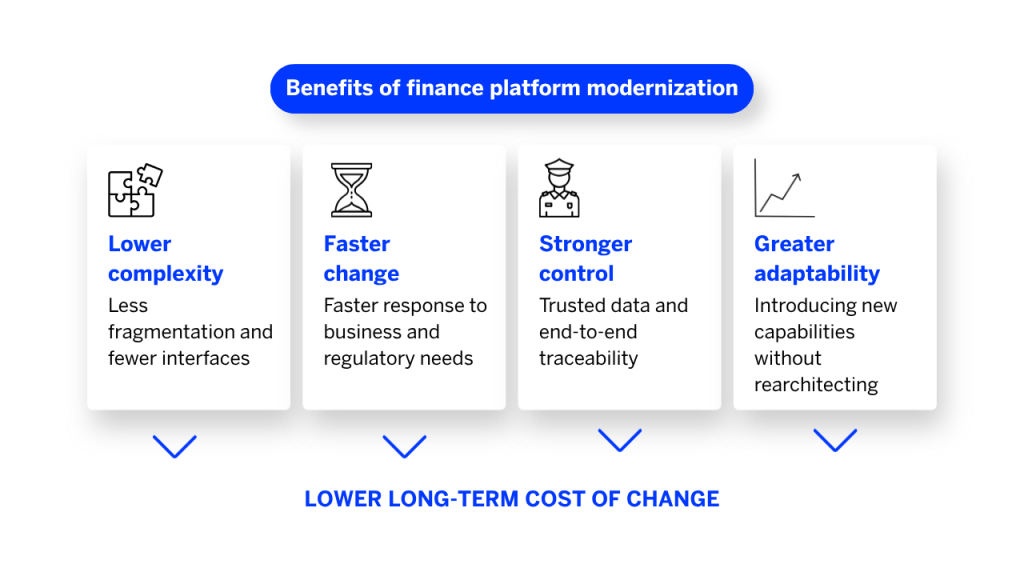
Finance architecture needs to evolve. The question is whether the next transformation will reduce complexity or recreate it.
To discuss how a platform-led finance data and control strategy can accelerate your modernization journey, request a call with our expert team.

Related posts

Why some digital finance modernizations fail (and how to ensure success)

5 data challenges in finance modernization that only industry-specific platforms can solve
Most read posts

What sets modern policy administration systems apart

The risk of staying stagnant: How corporate banks are stepping up in cash management with virtual account solutions

Virtual account management: the quick win for a stronger cash management proposition
More posts
Get up to speed with the latest insights and find the information you need to help you succeed.