The next phase of financial services: Moving beyond standalone agents to trusted, agentic finance execution
8-minute read
Published on: 30 September 2026
AI is rapidly reshaping the financial services industry with banks investing heavily in AI platforms, copilots, agents and enterprise AI ecosystems to transform how they operate. Yet despite this investment, many institutions still struggle to move beyond isolated proofs of concept and pilot programs toward AI-enabled finance operations at scale. This gap is reflected in BCG’s 2025 study that found only one-quarter of financial institutions are using AI to strengthen their competitive position, while the rest are still largely experimenting at the margins.
Standalone AI agents have played an important role in demonstrating value across targeted use cases, helping banks improve productivity, automate individual tasks, and accelerate decision-making. However, scaling these benefits across core finance operations requires a deeper integration with trusted data, finance expertise, and governed execution.
The challenge is no longer access to AI. Most banks already have an AI strategy, preferred models, and emerging agent ecosystems. The challenge is connecting those AI capabilities to trusted finance data, domain expertise, and governed execution in a way that remains secure, explainable, auditable, and compliant.
The future of finance will therefore not be defined by standalone AI agents operating independently. It will be defined by how effectively banks integrate their AI ecosystems with trusted finance platforms that provide governance, business context, and controlled execution.
AI alone is not enough: finance functions need governance, control, explainability and auditability
Finance functions operate under a unique set of requirements. Regulatory reporting, financial controls, risk management, treasury operations and accounting processes all rely on trusted data, approved workflows and clear accountability.
While many AI applications can tolerate a degree of uncertainty, finance processes require accuracy, precision, and deterministic execution to ensure that key decisions are taken on a substantiated basis. AI can augment these activities, but it cannot replace the governance, controls and accountability that underpin trusted finance operations. Furthermore, these processes cannot rely on outputs that lack transparency or cannot be explained and audited.
This creates a fundamental challenge for banks as they develop their own AI ecosystems.
Large Language Models (LLMs) are probabilistic by design. They generate recommendations and outcomes based on patterns and probabilities. Finance functions, on the other hand, require determinism, traceability and clear accountability. As a result, simply deploying an AI agent is not enough.
The organizations generating meaningful value from AI are not treating it as a separate layer sitting next to finance. Instead, they are embedding AI directly into governed finance processes where clear controls and business rules already exist.
The starting point is trust. AI is only as effective as the data, controls, workflows, and governance that sit beneath it. In finance, trust means that insights, recommendations, and actions can be substantiated against reliable data and business rules, traced to their source, and verified through auditable processes. Without a trusted foundation, concerns around explainability, compliance, security, and auditability quickly become barriers to adoption.
This challenge becomes even more significant as banks develop their own enterprise AI ecosystems. Increasingly, financial institutions are not looking for isolated AI solutions that operate independently from the rest of their technology landscape. They are building centralized AI architectures and expect business applications to integrate seamlessly into them.
The requirement is no longer simply “does this software have AI?” The requirement is increasingly “can this software connect to our AI ecosystem while maintaining the governance and controls required by finance?” This distinction is critical.
The future of AI in banking will not be built around standalone agents operating outside controlled environments. It will be built around trusted platforms that enable AI to operate safely within clearly defined guardrails, while connecting seamlessly to the broader AI ecosystems that banks are already creating.
This is precisely the role of SAP Fioneer’s Autonomous Finance Suite. It connects customer AI ecosystems with trusted finance data, domain intelligence, reusable business capabilities, and governed execution, enabling AI-driven finance operations without compromising control, compliance, or auditability.
Enabling trusted AI adoption through the Autonomous Finance Suite
At Fioneer, we believe the path to successful AI adoption is not about replacing our customers’ AI strategies. It is about enabling and strengthening them.
Banks are increasingly building their own AI ecosystems, including enterprise AI platforms, copilots, agents, and preferred large language models. They want to retain control over these investments while ensuring AI can safely interact with finance processes and data.
This is precisely the role of the Fioneer Autonomous Finance Suite: to connect banks’ AI ecosystems with the finance knowledge, data, controls, and execution capabilities required for trusted agentic finance. The Suite brings together three complementary layers: the customer AI ecosystem, the Finoneer Financial Services AI Fabric, and the SAP Fioneer Finance Management Platform (FMP).
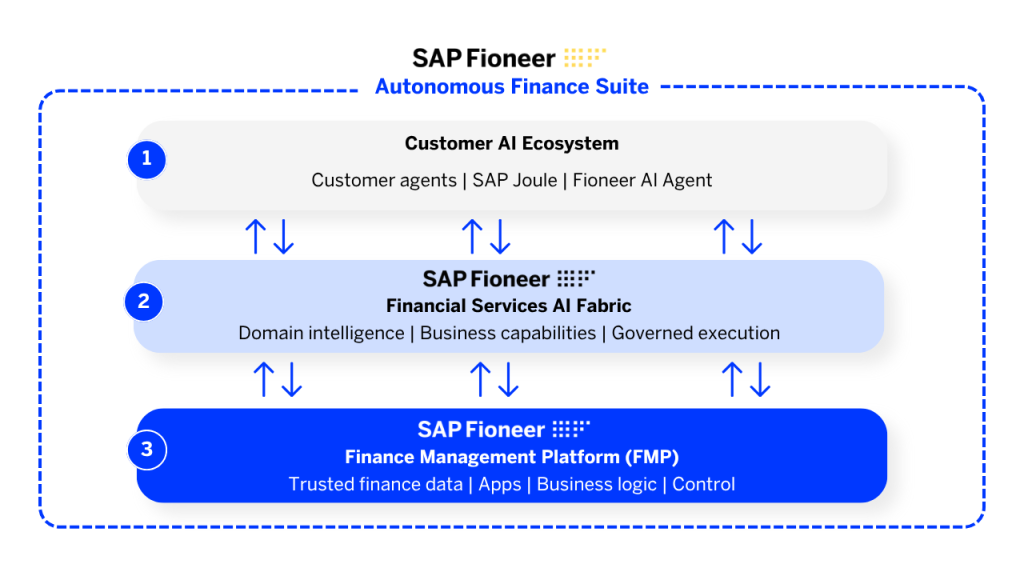
The Fioneer Finance Management Platform serves as the trusted foundation for finance operations. It provides the finance data, controls, business logic, and operational processes required across key domains including accounting, controlling, sustainability, risk, regulatory reporting, and treasury.
Building on this foundation, the Fioneer Financial Services AI Fabric acts as the bridge between finance operations and the broader AI ecosystems that banks are already creating.
Rather than forcing customers into a separate AI environment, the AI Fabric is designed to connect seamlessly with customer AI capabilities, including enterprise LLMs, intelligent agents, user interfaces, and future AI services. Through this approach, banks can continue leveraging their preferred AI tools while gaining access to trusted finance intelligence, reusable business capabilities, and governed execution.
The Fioneer Financial Services AI Fabric provides the enablement layer that connects AI systems to finance operations. It brings together finance domain intelligence, reusable business capabilities, governance frameworks, and controlled execution services, ensuring AI can operate within the guardrails required by financial institutions.
This architecture creates a clear separation of responsibilities. Customer AI ecosystems remain focused on interaction, reasoning, and user experience. The Fioneer Finance Management Platform provides the trusted system of record, finance processes, controls, and deterministic execution. The Fioneer Financial Services AI Fabric connects the two through curated finance knowledge and an understanding of the relationships and dependencies between data, products, and processes. This enables agents to work with the FMP in an accurate, controlled, governed, and auditable manner.
Why a financial services AI fabric matters
As banks scale AI adoption, a common challenge emerges: finance knowledge, controls, and integrations risk being rebuilt separately for every new AI agent.
Without a shared enablement layer, finance knowledge, data relationships, process dependencies, governance frameworks, and execution controls must be embedded separately into each agent. This fragments the overall finance context, duplicates integration and maintenance effort, and increases the risk of inconsistent knowledge, controls, and outcomes as the number of agents grows.
The Fioneer Financial Services AI Fabric takes a different approach.
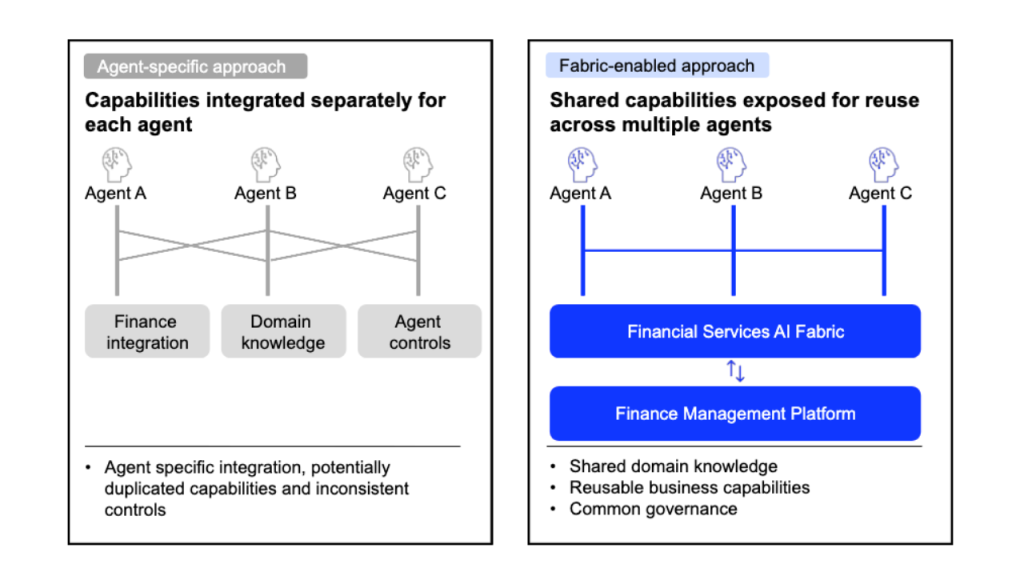
nstead of rebuilding finance knowledge within every agent, the AI Fabric provides a shared layer of curated, deterministic finance knowledge, and reusable business capabilities. It brings together knowledge, data, products, and processes while maintaining an understanding of the relationships and dependencies between them. Multiple agents can use this common context consistently across finance use cases.
A customer agent can connect to the AI Fabric and immediately access shared finance domain intelligence, reusable business capabilities, and common governance services that are anchored in the Fioneer Finance Management Platform. Rather than recreating integrations and controls for every agent, these capabilities are maintained once and reused consistently across theFioneer Financial Services AI fabric.
This provides three distinct advantages:
- Shared finance intelligence: curated finance knowledge, data relationships, process dependencies and business context are maintained centrally and reused consistently across multiple agents and applications
- Consistent governance and controls: agents operate under the same access rules, approvals, controls and compliance standards, producing outcomes that are substantiated, traceable and auditable across the AI ecosystem
- Deterministic and controlled execution: AI-driven recommendations can be translated into approved finance actions that remain traceable, auditable and governed
As a result, banks can innovate faster while maintaining a consistent and trusted operating model across their AI ecosystem with the Fioneer Autonomous Finance Suite.
The future is integration, not isolation
The banking industry has entered a new phase of AI adoption.
Success will not be defined by the number of AI agents a bank deploys, but by how effectively those agents connect to trusted finance operations.
AI provides reasoning and interaction capabilities. The knowledge graph within the Fioneer Financial Services AI Fabric provides curated, deterministic finance knowledge and context. The Fioneer Finance Management Platform provides the data, controls, and governed execution required to turn AI-generated recommendations into trusted finance outcomes.
The future of finance is therefore not about deploying standalone agents in isolation. It is about enabling agents to work together through a shared layer of trusted finance knowledge and connecting them to controlled, deterministic, and auditable finance execution. This is what we provide to our customers with the Fioneer Autonomous Finance Suite.
Want to learn more?
Contact us to discover how Fioneer Autonomous Finance Suite helps financial institutions scale AI with trust, control and measurable business value.

Related posts

Five capabilities of a modern accounting subledger

Liquidity moves in seconds. Can your bank respond in real time?

The subledger problem behind messy finance data
Most read posts

What sets modern policy administration systems apart

The risk of staying stagnant: How corporate banks are stepping up in cash management with virtual account solutions

Virtual account management: the quick win for a stronger cash management proposition
More posts
Get up to speed with the latest insights and find the information you need to help you succeed.