The digital euro is mandatory. Building it from scratch is not.
7 minutes read
Published on: 3 September 2026
Every euro-area bank offering payment accounts will have to distribute the digital euro. Most have not started. Here is what the build actually involves, and how much of it you do not have to write yourself.
By Christian Geist – Director Innovation & Head of Banking Solutions at SAP Fioneer
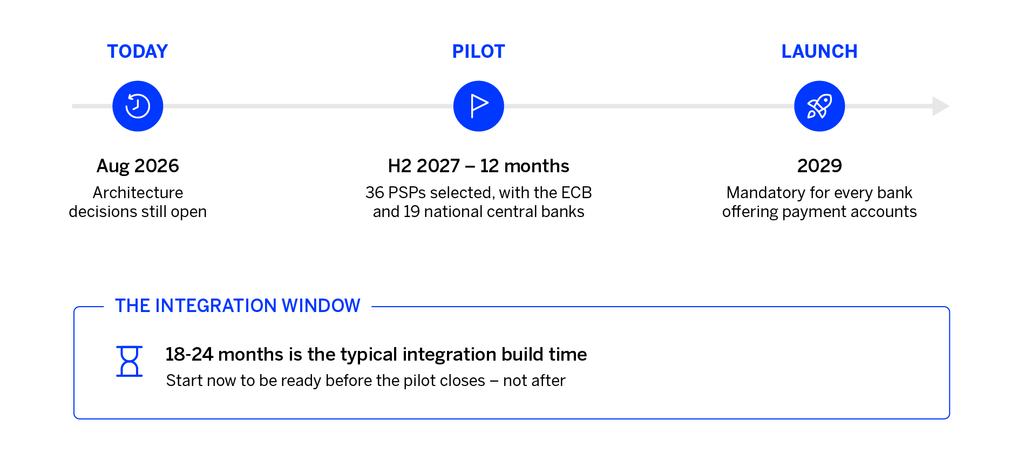
Following the European Central Bank’s (ECB) experimentation program, banks across Europe are now preparing for the next phase: a 12-month pilot expected to begin in the second half of 2027. ECB has selected 36 payment service providers from the euro area to participate in the digital euro pilot project. The pilot phase is of crucial importance for testing the technical functionalities and operational processes of the digital euro, as well as for optimizing the user experience. The pilot project is intended to support the ongoing preparatory work for the potential issuance of a digital euro. It is scheduled to begin in the second half of 2027 and last for 12 months.
For banks, this is no longer just another regulatory discussion. The digital euro is quickly becoming a strategic infrastructure topic that could reshape how payments, liquidity and digital services work in Europe.
It also reflects a bigger ambition: strengthening Europe’s payment sovereignty and reducing dependency on non-European providers.
The foundation is already there
One of the clearest outcomes from the ECB’s Pioneer experimentation program is this: banks do not need to start from scratch.
Modern banking architectures are already capable of supporting many digital euro requirements. During the experimentation phase, we integrated wallet functionality, payment orchestration, and conditional payment capabilities into its banking and payments platform using APIs from the Digital Euro Service Platform (DESP).
That matters because scalability and operational resilience remain major concerns for banks. Any future digital euro infrastructure must be able to securely process millions of transactions.
The good news is that many banks already operate high-volume, enterprise-grade systems today. By extending existing SAP S/4HANA-based infrastructures with digital euro capabilities, financial institutions can evolve their platforms instead of replacing them completely.For banks, that means less complexity, lower implementation risk and a faster path to readiness.
From experimentation to real banking use cases
The discussion around the digital euro is evolving. The question is no longer whether a digital euro could exist. The focus is now on how it can work at scale inside real banking ecosystems.
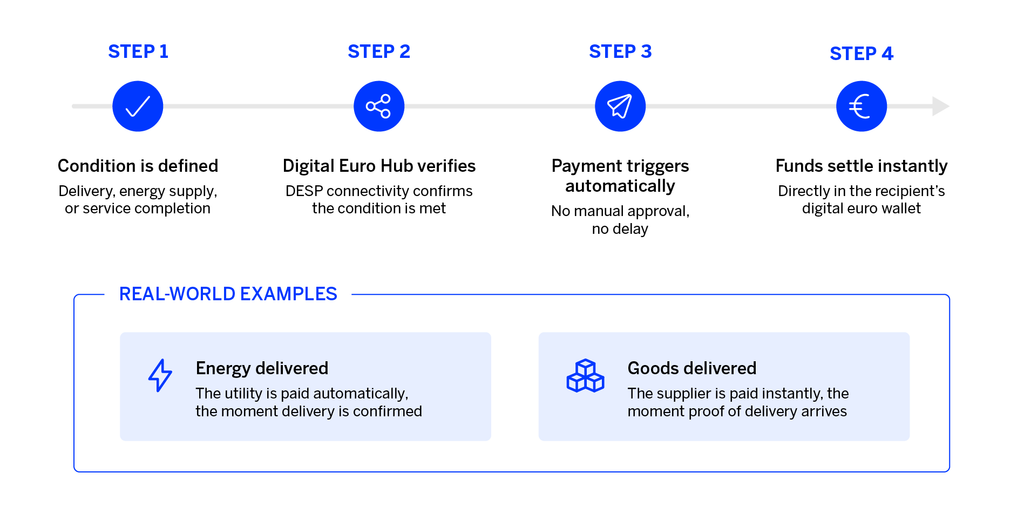
A key area explored during the ECB experimentation phase was conditional payments. These are payments that are triggered automatically once predefined conditions are met.
The concept becomes easier to understand through practical examples.
An electricity provider could receive payment automatically once energy delivery is confirmed. A supplier could be paid instantly after proof of delivery is received.
These automated processes can reduce manual effort, improve transparency and accelerate transaction processing.
For banks, this opens the door to new services and business opportunities. Payments are increasingly becoming more than simple transaction processing. Value creation is shifting toward orchestration, automation and embedded financial services.
Interoperability will be critical
The success of the digital euro will depend heavily on interoperability. Banks, fintechs, payment providers and central infrastructure operators all need to work together within a connected ecosystem. Without common standards and seamless integration, adoption could quickly become fragmented and inefficient.
This is why open and modular architectures matter.
Standardized APIs and flexible banking platforms allow institutions to integrate digital euro functionality into existing processes without disrupting their core systems.
In other words, interoperability is not just a technical requirement. It is the foundation for scale and long-term adoption.
Trust and privacy remain non-negotiable
No digital currency initiative will succeed without consumer trust.
Customers and businesses need confidence that their transactions are secure, and their data is protected.
This makes security-by-design and privacy-by-design essential from the start. Capabilities such as encryption, role-based access controls, continuous monitoring, pseudonymization, and data minimization must be embedded directly into the platform architecture.
Banks already operate in highly regulated environments and manage sensitive financial data every day. That positions them well to act as trusted intermediaries in a future digital euro ecosystem.
For financial institutions, this is not only about compliance. It is also an opportunity to strengthen customer trust through secure and reliable digital services.
Why banks should start preparing now
Even though the digital euro is still evolving, the strategic implications are already becoming clear.
Banks that engage early can:
• Build operational experience with digital euro workflows
• Test integration approaches within existing infrastructure
• Explore new payment services and commercial models
• Reduce implementation risk later on
• Prepare for future regulation and customer adoption
Early participation also gives banks the chance to help shape future standards instead of reacting to them later.
The transition to central bank digital currencies (CBDCs) will take time. But the institutions gaining hands-on experience today are likely to be better positioned as the market matures.
Preparing for the next phase
The next stage of the ECB initiative is expected to focus on deeper wallet management capabilities, funding mechanisms, and more advanced transaction processing.
For banks, that signals an important shift.
The digital euro is no longer just a policy topic. It is becoming an operational and architectural challenge that requires scalable technology, regulatory expertise, and strong integration capabilities.Sh
This is where experienced banking technology partners become critical.
That is what we built the SAP Fioneer Digital Euro Hub for. It covers digital euro wallet management, DESP connectivity and payment orchestration in one platform, for both the distributing and the acquiring side, as standard software rather than a one-off project. Around 60 percent of it is the core banking and payments technology we already run for more than 1,200 institutions. It is ready for the pilot and built to carry straight into full-scale rollout, and it deploys beside your existing programmes, not inside them. Banks stay free to retain, replace or extend any part of it later; taking part in a pilot on it commits you to nothing.
At SAP Fioneer, the goal is to help financial institutions prepare early with digital euro capabilities that combine compliance, interoperability, and enterprise-grade performance.

Related posts

Control risk before it escalates: Why workflow governance matters in mortgage servicing

The 360-degree borrower view: Why servicing teams need a complete customer picture

The hidden cost of fragmented loan documentation
Most read posts

What sets modern policy administration systems apart

The risk of staying stagnant: How corporate banks are stepping up in cash management with virtual account solutions

Virtual account management: the quick win for a stronger cash management proposition
More posts
Get up to speed with the latest insights and find the information you need to help you succeed.