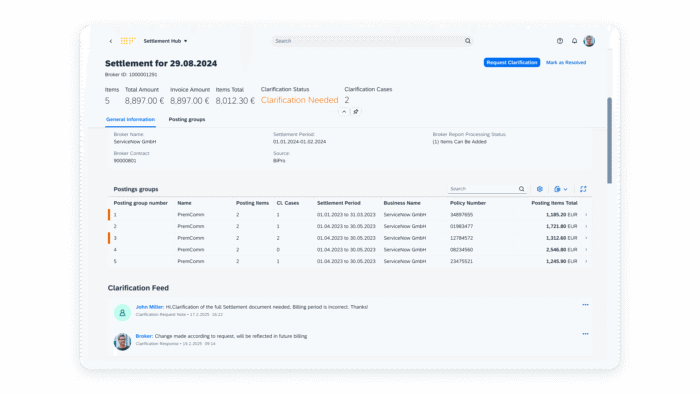
Transform insurance billing and payments

Built for the insurance industry, Collections and Disbursements (FS-CD) simplifies and centralizes all collections and disbursements, streamlining premium billing, payments, and settlements across all lines of business, reducing costs, improving transparency, and delivering a better experience for policyholders, brokers, and partners.
Proven results from hundreds of financial institutions worldwide

50%

overheads savings after system consolidation

73%

faster reconciliation with general and subledger

>98%

automation of incoming payments

Why leading insurers choose our platform

  • Bring all financial transactions into one platform to reduce errors, cut costs, and increase visibility—enabling better cash flow, lower risk, and faster decision-making across the business.

  • Connect with existing billing and CRM systems without custom development. Scale confidently with out-of-the-box capabilities designed to handle high volumes without slowing down.

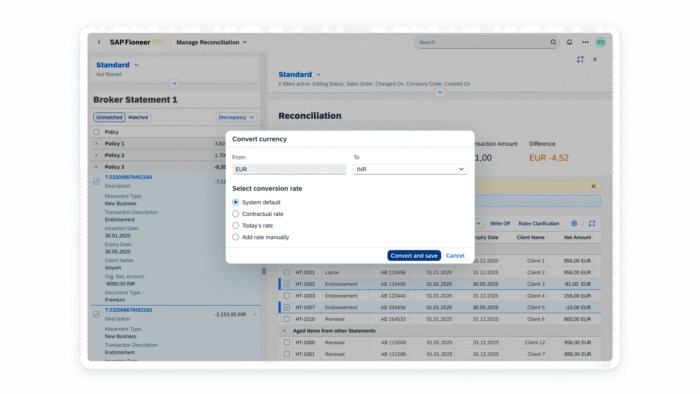
  • Enable real-time, multi-currency, and digital payments with full documentation—speeding collections and disbursements while improving both operational efficiency and customer experience.

  • Support flexible, policyholder- and broker-oriented billing models with faster, more transparent processes—improving retention and protecting relationships across the insurance value chain.

  • Connect existing billing and CRM systems effortlessly with platform-agnostic integration. Ensure consistent, real-time data sharing across your technology stack without complex custom development or lengthy implementation timelines.

Powerful capabilities that drive results

Unified platform

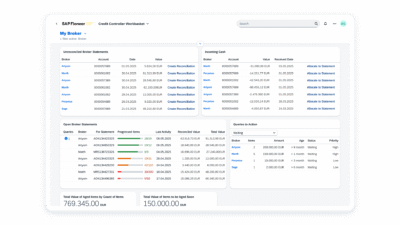
Consolidate all billing and payment processes across customers, brokers, and partners in one intelligent system for complete visibility and control.

Flexible, fast payments

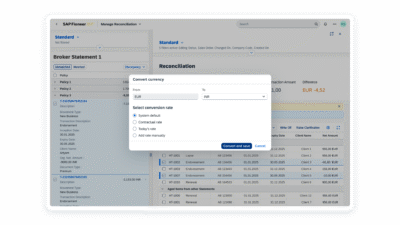
Handle real-time, multi-currency, digital payments, and diverse transactions such as partial payments and refunds, ensuring fast payouts and better customer experience.

Automated, compliant collections

Streamline collections with automated dunning, audit-ready processes, and consistent communications aligned to regulatory standards.

Configurable billing cycles

Generate invoices with flexible billing schedules and accurate premium calculations aligned to policy or contract terms.

Transparency and compliance built-in

Achieve timely, accurate, and auditable financial closing with integrated balance confirmation, reconciliation, accruals, and journal postings.

Real-time financial insights

Access structured reports on key financial metrics and trends that drive better forecasting, profitability tracking and strategic decisions.

Support for co-insurance

Manage complex co-insurance and reinsurance contracts across proportional, facultative, and other models.

Connected platform

Seamlessly integrate with SAP and third-party systems for streamlined, accurate collections processes and reliable data flow across your tools.

We operate FS-CD as a central platform and service for multiple of our countries and lines of business. Particularly noteworthy are our proven best practice processes, which enable us to introduce FS-CD in new markets within a manageable period of time and cost that is acceptable even to smaller units.”

Stefan Tretter

Head of Global Billing & Payments IT at Zurich Insurance

Zurich Insurance company logo.

Frequently asked questions

SAP Collections and Disbursements, commonly known as FS-CD, is a specialized subledger for managing insurance receivables and payables. It connects billing, collections, payments, disbursements, and clearing across premiums, claims payments, refunds, commissions, and partner transactions, keeping these activities within a consistent financial record.

FS-CD supports the financial lifecycle across insurance billing, incoming and outgoing payments, matching and clearing, overdue collections, returns, write-offs, disbursements, broker collections, and reporting. Each activity remains connected to the relevant contract account, insurance relationship, and financial record.

FS-CD supports financial processes across life, health, and property and casualty insurance, as well as receivables, payables, and settlement activity related to reinsurance and co-insurance. It is particularly relevant for insurers managing high transaction volumes, multiple lines of business, complex partner relationships, or operations across several entities and markets.

FS-CD is designed to manage high transaction volumes and complex insurance billing scenarios across multiple currencies, entities, products, and lines of business. Its insurance-specific data model supports contract accounts, insurance relationships, payment methods, broker collections, correspondence, clearing, and related financial processes.

Insurance billing must account for premiums, claims payments, refunds, commissions, broker relationships, payment plans, collections rules, and complex receivable and payable positions. An insurance-specific solution keeps these processes connected to the relevant policy, contract, partner, and financial records instead of treating them as generic invoices and vendor payments.

FS-CD brings invoicing, payment matching, clearing, overdue collections, returns, and disbursements into controlled financial processes. Automation reduces recurring manual work, while configurable workflows help teams handle high transaction volumes consistently and focus on exceptions that require review.

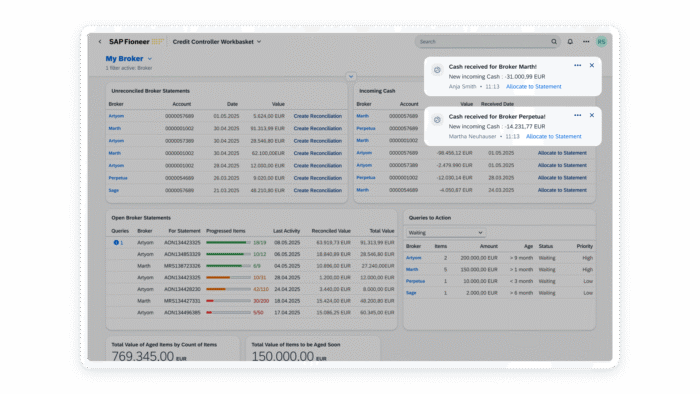
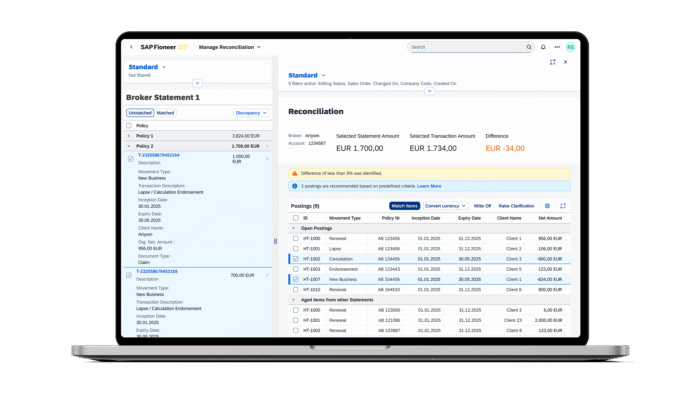
FS-CD processes incoming payments, matches them to open items, clears receivables and payables, and directs unclear transactions into clarification processes. Keeping payment activity connected to the relevant open item helps finance see what has cleared, what remains outstanding, and what still requires action.

FS-CD keeps return information, retries, overdue collection activity, reversals, write-offs, and final treatment connected to the affected open item through the recovery process. This reduces the need to reconstruct the position from separate trackers, local reports, or communication threads.

FS-CD supports payment processing and clearing and can manage open items for outgoing instant payments. It creates payment requests that can be processed through a connected treasury management system, helping faster payment execution remain linked to the underlying open item and financial process.

FS-CD keeps open items, payment requests, clearing, settlement information, and exceptions connected to the finance record. This helps finance distinguish between a payment that has been initiated or processed and one that has been matched, cleared, and fully reflected in the financial position.

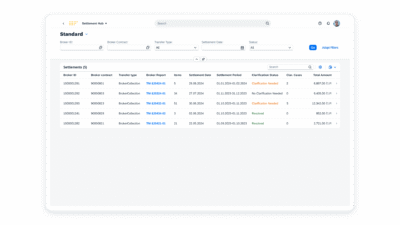
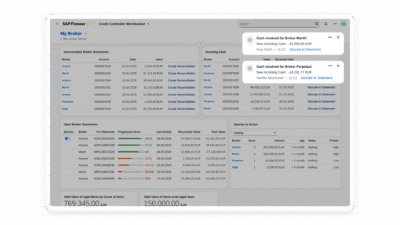
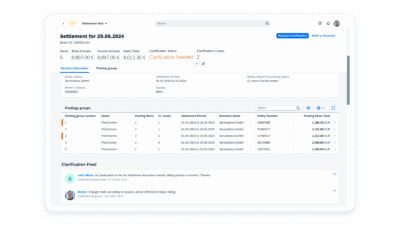
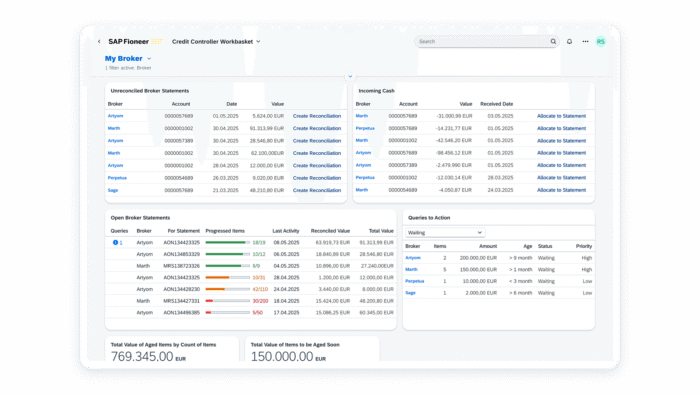
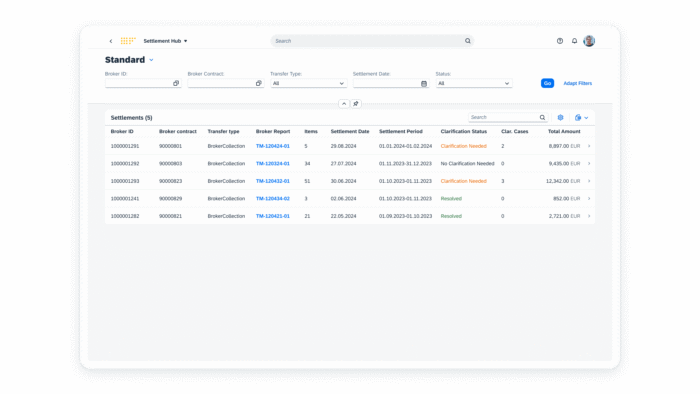
FS-CD supports standardized information exchange with broker management systems for broker settlement processing. Settlement data can be used to create broker reports in FS-CD, while connected broker systems can receive corresponding reports from FS-CD. This helps keep broker settlement activity connected to the receivables and financial records that finance needs to manage.

FS-CD keeps broker settlement activity connected to receivables and reconciliation processes. Finance can maintain visibility into settlement records, open positions, and items that still require attention, reducing the risk that unresolved differences age without a clear status or supporting record.

FS-CD is designed to connect insurance systems such as policy, claims, and commission management with finance, payment, treasury, and general ledger processes. It supports transactional data from insurance core systems and can operate within SAP and non-SAP technology environments.

FS-CD keeps postings, clearing, corrections, reversals, adjustments, and approvals within an auditable financial record. This gives finance a traceable path from the originating insurance event through subsequent changes to the final position, reducing reliance on spreadsheets, email threads, or individual memory to explain what happened.

FS-CD maintains receivables, payables, postings, clearing, adjustments, and balances in a unified subledger and connects these records to general ledger processes. Finance teams can review open positions and transaction histories without rebuilding the supporting record across separate systems.