Five ways to the digital euro (and why the choice falls in the next 12 months)
8-minute read
Published on: 6 November 2026
The digital euro is central bank money in digital form, issued by the Eurosystem and distributed to customers through banks and payment service providers.
For banks, preparing for it involves a fundamental choice: wait, build in-house, outsource development, buy a partial solution or choose an end-to-end solution.
Each path comes with different implications for cost, resources, risk and time to market. And given the timeline ahead, banks may need to make that choice sooner than they think.
Why the digital euro deadline is closer than it seems
The digital euro is one project among many on a bank’s agenda. What makes it different is the timeline.
According to the ECB (July 2026), 36 payment service providers have been selected for the pilot. The operational phase of this pilot is due to start in the second half of 2027 with a first issuance following in 2029.
That might seem far away right now, but count back and think about how long this implementation will take.
Rework and soft launch can take around 12 months. Implementation, testing and acceptance can require another 12 to 18 months. Then vendor selection, tendering and contracting can add another six to 12 months. And before any of this comes budgeting.
So for banks sitting outside the pilot, that points to the 2027 budget cycle.
In other words: 2029 means 2027.
“Waiting is the most expensive option of all,” says Marko Wenthin, responsible for the digital euro market at SAP Fioneer. “Time pressure is the biggest cost driver in regulatory projects.”
So, what are the options?
What are the five ways to digital euro readiness?
Banks have five main paths to digital euro readiness. The differences come down to cost, risk ownership, time to market and who maintains the solution as the rulebook evolves.
Let’s take a look at these five options.
1. Wait and see
This is the most common response we’ve seen during our conversations. And it’s understandable – waiting requires little to no short-term investment. Plus, it gives banks the opportunities to watch and learn from the pilot and early implementations.
But there’s a trade-off. Every month spent waiting reduces the time available for preparation. A late start can mean choosing vendors, integrating systems and testing under greater time pressure.
By then, the rulebook, interfaces and first reference implementations will also have been shaped by others.
Sitting on the fence and not deciding is still a decision.
2. Develop in-house
Building in-house gives a bank control over the solution and the freedom to customize it around its existing architecture.
Having that control comes at a cost, though. The bank has to ensure the engineering capacity to develop, test, operate and maintain the solution over time. It also owns the impact of all future rulebook changes. When requirements change, the bank will have to update its own code every time.
Many banks can build their own solution. But it’s not a question of capability. It’s whether this is where they want to be investing their already scarce engineering resources.
3. Outsource development
The obvious next option to developing a custom digital euro solution is to outsource that development. This allows a bank to access external expertise and still develop a solution around its own requirements.
It can reduce the need for internal development capacity, but doesn’t remove the complexity of maintaining a custom solution. Instead, part of that responsibility moves to consulting and implementation partners.
That relationship continues long after go-live and changes to the rulebook risk becoming an entirely new development project or change request.
Options 2 and 3 therefore share an important characteristic: the bank still operates a solution built specifically for its environment. The main different is who builds it and where the delivery risk sits.
4. Buy a partial solution
A software provider can supply individual elements of the digital euro architecture, such as a connector to the Digital Euro Service Platform (DESP), the Eurosystem’s central platform for digital euro transactions.
This can accelerate implementation of a specific component, but the remaining capabilities still need to come from somewhere. These can include wallet management, funding and defunding, waterfall and reverse waterfall processes and merchant acquiring.
Working with several providers also means integrating several components. Those integration points can add cost and complexity to the overall project.
For banks taking this route, the important question is therefore not only what an individual component provides, but how the complete architecture will work together.
5. Buy an end-to-end solution
An end-to-end solution brings all digital euro capabilities together in one single solution rather than integrating individual components from several providers.
Access, liquidity and transaction management can share a common standard. Rulebook changes can also be implemented centrally by the provider rather than rebuilt separately by each bank.
This approach favors standardization over individual customization.
That trade-off may make sense for a scheme where the underlying rules are defined by the Eurosystem. Banks can then focus differentiation on areas customers experience directly, such as their channels, apps and merchant services.
From an architecture perspective, an end-to-end solution can operated as a second ledger alongside the existing core. It synchronizes positions, holding limits and waterfall processes with the current account in real time, while limiting the changes required in the core.
The aim is straightforward: configure standard capabilities where possible and focus development resources where they create differentiation.
How should a bank choose its digital euro path?
There are four questions banks can ask themselves to decide which of the five paths above fit their situation:
- Budget and resources: How much engineering capacity can you dedicate to the digital euro in 2027 and 20238?
- Operating risk: Who should carry the risk when the rulebook changes after go-live?
- Standardization: Does the digital backend differentiate your bank or is it infrastructure that needs to work reliably?
- Time to market: How quickly does your bank need to be ready?
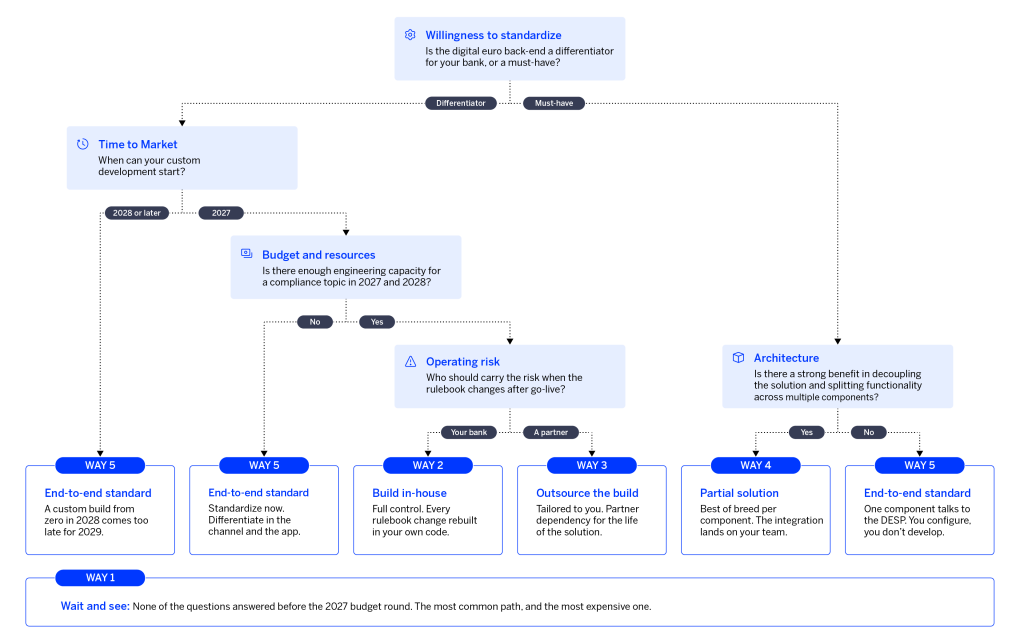
Notice that none of these are purely technical questions – they’re business and operating model decisions.
One pattern we’ve seen in our conversations with banks is that they begin by answering the third question first. This simplifies the other questions and helps them decide faster.
If the digital euro backend isn’t an area where banks need to differentiate, using significant engineering capacity to build and maintain standard capabilities may be difficult to justify. If it is strategically important, greater customization and ownership may make sense.
That decision helps narrow the five paths.
For a more details looks at the underlying requirements, including wallet management, DESP connectivity and payment orchestration, read our white paper, Is your bank ready for the Digital Euro?
Frequently asked questions about the digital euro
Beyond the choice of implementation path, we’ve collected four of the most common questions we’ve seen in our conversations with banks below:
Do savings banks and cooperative banks have to implement the digital euro individually?
No. Central IT providers can implement capabilities across their networks, which is also where standardization can offer significant advantages.
A rulebook change can be implemented once and rolled out across many institutions. For a network, this can improve the economics of a shared platform by spreading fixed costs across more participants and transactions.
Will the digital euro cannibalize existing payment revenue?
Partly. Particularly in the card environment. But that isn’t the whole picture.
With the digital euro, some of the roles performed by card schemes and processors today will be taken over by the Eurosystem. There will also be a regulated inter-PSP fee.
With the digital euro, some of the roles performed by card schemes and processors today will be taken over by the Eurosystem. There will also be a regulated inter-PSP fee.
Whether the overall effect is positive or negative will depend on how a bank designs its offering. That makes it a product decision rather than a foregone conclusion.
Who monitors digital euro wallet balances, waterfalls and reconciliation?
The bank does, in a second ledger.
Positions, holding limits, waterfall and reverse waterfall processes and reconciliation with the current account run in the digital euro layer alongside the core.
Commercial bank money and central bank money need to remain synchronized through refunds, disputes and error cases. That’s why the account side of the digital euro architecture is just as important as the payment side.
Is it enough for a bank to meet the digital euro obligation minimally?
Yes. But there’s a strategic trade-off.
The provider of the wallet manages an important part of the customer’s relationship with central bank money. A minimal implementation may therefore mean leaving more of that relationship to another provider.
Banks should decide whether they see the digital euro primarily as a compliance requirement or as an opportunity to shape a new customer proposition.
There are several ways to prepare for the digital euro and the right choice will depend on each bank’s priorities.
SAP Fioneer’s approach is based on standardization. The SAP Fioneer Digital Euro Hub brings together digital euro wallet management, DESP connectivity and payment orchestration in one platform for both the distributing and acquiring sides – ready for the pilot phase and built to carry straight into the full-scale rollout.
Connect with one of our experts for a 30-minute chat about where your bank is today and how we can help get you on the right path to digital euro readiness.

Related posts

Digital euro pilot: most of what banks need for 2029 is already in scope
Most read posts

What sets modern policy administration systems apart

Virtual account management: the quick win for a stronger cash management proposition

The risk of staying stagnant: How corporate banks are stepping up in cash management with virtual account solutions
More posts
Get up to speed with the latest insights and find the information you need to help you succeed.