Modernizing finance without losing control: The subledger’s role
Published on: 14 April 2026
Finance modernization represents a foundational shift in how financial institutions operate, steer the business, manage risk and meet regulatory expectations. To modernize, banks and insurers require an integrated finance and risk architecture that provides trusted data, standardized processes and the agility to adapt to rapid market and regulatory change.
SAP and SAP Fioneer support this shift with a purpose-built subledger. Together with a mature ecosystem of partners and industry accelerators, they provide holistic support for finance, risk and control processes, enabling institutions to standardize, simplify and modernize end-to-end operations.
This article outlines where the product subledger fits in that platform, why it becomes the accounting and measurement cornerstone and how its integration and scalability help institutions maintain control, reduce audit risk and make better decisions as complexity grows.
Where the subledger fits in a modern finance platform
Most institutions don’t modernize finance in one leap. They modernize across systems that were built at different times foMost institutions don’t modernize finance in one leap. They modernize across systems that were built at different times for different purposes. The result is duplicated data, inconsistent calculations, and heavy reconciliation between finance, risk and regulatory reporting. A unified platform approach addresses this by standardizing processes on a shared architecture and data foundation.
With SAP and SAP Fioneer’s platform approach, financial institutions:
- Simplify and standardize finance, risk, regulatory disclosure and management-control processes through a homogeneous and integrated architecture.
- Break down silos between finance and risk by consolidating fragmented data and processes into a single, harmonized framework.
- Support enterprise steering and control, reconciling and substantiating data across the entire end-to-end accounting and reporting lifecycle.
- Ensure consistency through a centrally harmonized data model and a unified interface.
- Meet global regulatory requirements with content for iRef, FINREP, COREP and other core regimes.
This platform philosophy allows institutions to evolve from manually stitched-together financial processes to a cohesive, automated and transparent operating model.
At the center of this architecture sits SAP Fioneer’s subledger, the engine that anchors essential finance processes and ensures accuracy, transparency and audit credibility.
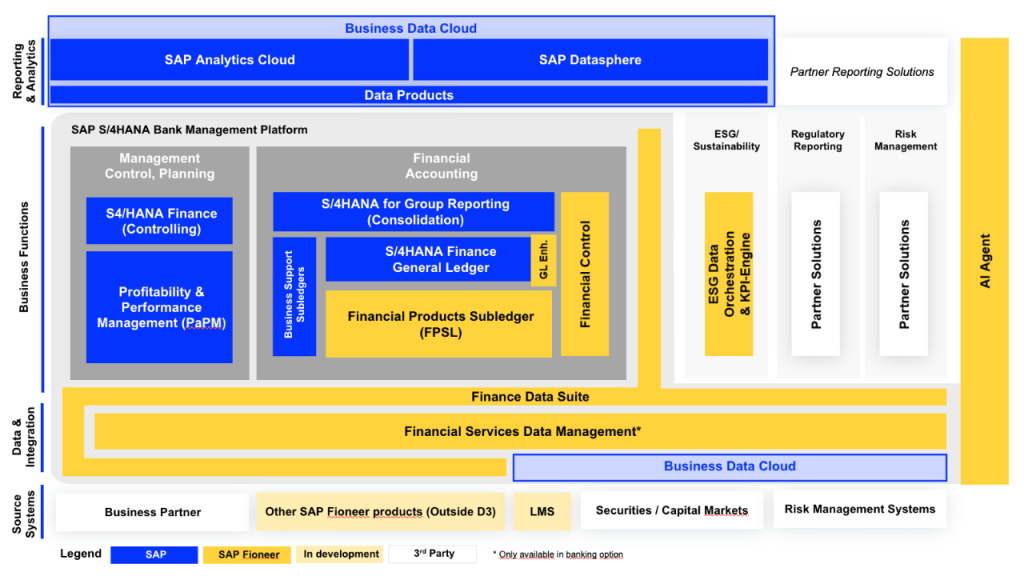
The subledger as the finance platform’s accounting and measurement core
As the core accounting and measurement layer for financial products, the subledger:
- Delivers a standardized accounting process across all products and entities
- Embeds industry-standard rules and regulatory logic
- Provides persistent, granular and traceable data
- Enables multi-GAAP accounting from a single data source
- Supports all accounting workflows across the value chain
By centralizing the most complex components of financial accounting, the subledger reduces operational risk, eliminates duplication, and creates a single source of financially trusted truth for finance, risk, and management.
How the subledger integrates across the finance platform
The subledger integrates seamlessly with SAP’s broader platform.
When combined with SAP’s S/4HANA and SAP Fioneer’s data management solutions, the subledger enriches and consumes risk and transactional data, ensuring:
- Consistent KPIs
- Alignment of risk and finance views
- Harmonized data for regulatory reporting and management steering
It provides standardized, ready-to-post financial outputs that keep the general ledger lean, stable, and focused on summary-level reporting.
Built-in integration also enables end-to-end visibility, from drill-down from summary positions to contract-level events, providing the transparency required by auditors, regulators, and senior management.
Built to scale and adapt to regulatory change
SAP Fioneer’s subledger is designed to handle the continuous changes of modern finance.
Used by some of the worlds largest banks and insurers, the subledger is built to scale and supports:
- High-volume retail products
- Complex capital markets portfolios
- Long-duration insurance contracts
- Multi-entity, multi-country operations
With it, financial institutions can process the industry’s largest data volumes with reliability and performance.
To keep up with regulatory changes, financial institutions can adopt new GAAPs, standards and reporting mandates without re-platforming, and extend the subledger to support:
- New measurement models
- New products
- New regulatory rules
- New accounting classifications
The subledger also provides a foundation for innovation, such as implementing and adopting AI and predictive analytics. With its standardized, reconciled event-level data, the subledger enables:
- AI-driven anomaly detection
- Automated controls
- Real-time profitability analysis
- Forward-looking simulation
- Predictive insights for management steering
With the platform foundation in place, the next step is consolidation where fragmentation is highest: at the line-of-business layer. The following section shows how the subledger helps rationalize multiple subledgers across Lines of Business (LoB).
How the subledger enables modernization across lines of business
By addressing the unique demands of specific Lines of Business (LoB), the subledger helps financial institutions streamline operations and meet regulatory and business requirements effectively. This is where modernization often succeeds or fails: too many ledgers, often a result of past mergers and acquisitions, create reconciliation overhead, inconsistent results and higher audit risk.
For instance, the capital markets division within a large bank might maintain dozens of subledgers—sometimes 40 or more—across securities, loans and derivatives.
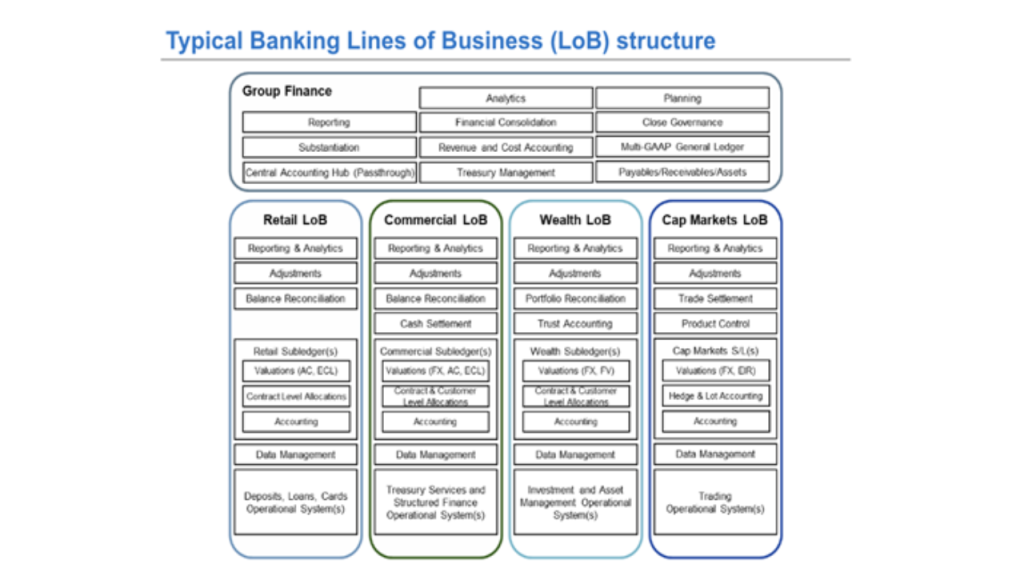
Since each LoB is accountable for compliant financial reporting aligned with its operations and for ensuring accurate reconciliation with underlying systems, it needs a single source of truth.
SAP Fioneer’s subledger offers a comprehensive solution for LoBs, accommodating a wide range of product types. Instead of maintaining separate subledgers, financial institutions can consolidate their architecture into a smaller, more efficient structure. This reduces operational costs, simplifies infrastructure maintenance, and enables support for multiple LoBs in parallel.
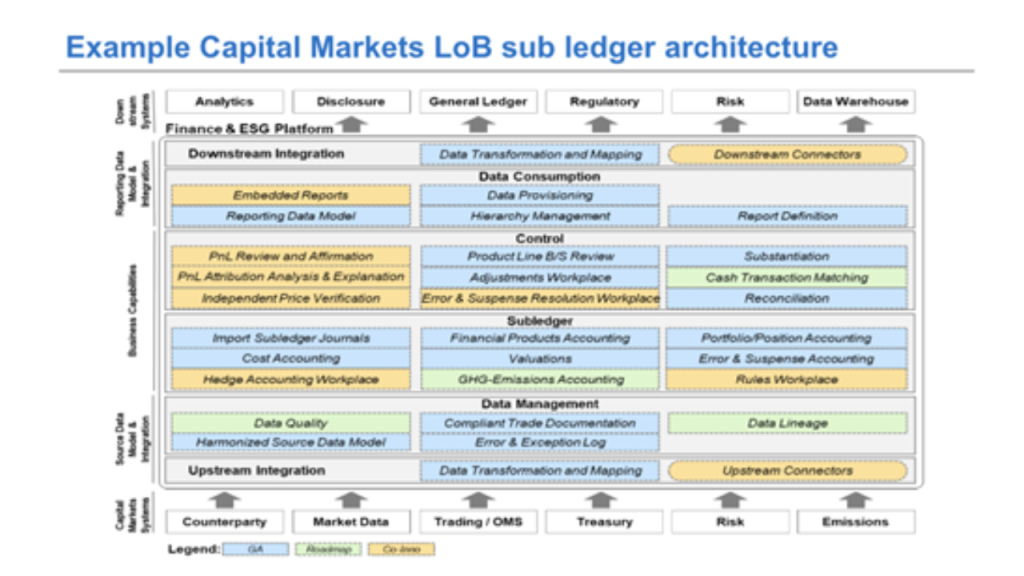
Banking example: Capital markets consolidation and ABOR
In capital markets, banks can leverage the product subledger as an Accounting Book of Record (ABOR)—a certified, audit-ready source for daily P&L and positions—to generate daily results with full traceability. This ensures:
- Timely decision-making. Certified data enables accurate and prompt insights, critical for navigating volatile market conditions.
- Improved business efficiency. Harmonized data models and integrated processes reduce operational redundancies while enhancing controls.
- Cost optimization. Automated compliance with multi-GAAP requirements and audit trail capabilities lowers the cost and complexity of regulatory adherence.
SAP Fioneer’s subledger also resolves key challenges in capital markets, such as:
- Harmonizing data models that were fragmented across disparate systems.
- Managing complex valuation and fair value measurement processes.
- Integrating risk management frameworks and maintaining robust data governance.
Insurance example: Investment accounting across entities and regimes
Insurers often face similar fragmentation in investment accounting: multiple systems across legal entities and regions, plus parallel reporting under IFRS and local statutory GAAP. SAP Fioneer’s subledger provides a single accounting and measurement layer for assets, producing consistent multi-GAAP results from one trusted dataset. This reduces reconciliation, strengthens audit traceability, and improves transparency into drivers of investment income and volatility.
Key challenges addressed include:
- Reconciling investment positions and valuations across custody, asset management and finance systems
- Producing parallel multi-GAAP views (IFRS and local statutory) without duplicating processes
- Managing valuation complexity (amortized cost vs. fair value, impairment) consistently across portfolios and currencies
Personalization across LoBs: One model, tailored outputs
The SAP Fioneer’s subledger’s standardized but adaptable data model supports granular, event-based transaction data from diverse sources. This flexibility enables personalization to meet the specific needs of different LoBs:
- Asset classes and accounting categories. The subledger tailors accounting processes and reporting structures based on financial instruments, ensuring compliance with complex accounting standards.
- Region or jurisdiction-specific standards. The subledger simplifies local compliance with built-in jurisdiction-specific customizations.
The subledger’s ability to customize for specific LoB needs aligns closely with its integration into broader technology ecosystems, such as SAP S/4HANA. This relationship allows banks to extend their financial capabilities while ensuring scalability, operational efficiency and consistency across enterprise processes.
A practical adoption path for the product subledger
With the role of the subledger established, the next question is adoption. How can financial institutions implement it pragmatically without stalling broader modernization.
The product subledger modernizes finance operations by improving compliance, reporting accuracy and timeliness. But because it touches complex accounting and data flows, adoption can feel daunting, especially when institutions are balancing legacy constraints and competing priorities. A structured, modular approach helps teams deliver value early while reducing implementation risk.
SAP Fioneer’s modular architecture is designed to integrate with existing systems without sacrificing the granular detail financial services firms need.
Reducing cost and complexity without a general-ledger replacement
Integrating detailed accounting processes often requires upgrading legacy systems or designing complex data transformation workflows, which are both costly and time-intensive. For many large financial institutions, a disproportionate share of finance modernization effort and spend goes into establishing a modern, multi-dimensional ledger as the foundation for modernizing reporting and analytics. However, we believe the business value and objectives for finance modernization are largely enabled in the subledger.
The subledger’s modular architecture helps mitigate implementation hurdles by reducing cost, risk and time. It enables seamless integration with existing general-ledger systems—even non-SAP solutions—by centralizing accounting rules and logic. It also eliminates the need for an immediate general ledger replacement, allowing legacy systems to route data through the product subledger for enhanced reconciliation and reporting. Over time, banks can expand functionality to adopt “full accounting” for complex processes like risk provisioning, while prioritizing quicker wins in areas like reporting and audit readiness.
The product subledger comes with an in-built ETL layer, which easily allows building connections to core banking and risk management systems. By introducing a subledger before or alongside the general ledger, banks can avoid time-consuming debates between finance and technology teams as well as costly mistakes. This simultaneous deployment allows finance teams to work with a unified general-ledger/subledger code block from the outset, enabling progressive changes to the chart of accounts and regional or product-specific reporting without disrupting the general ledger system.
Banks can even adopt the product subledger incrementally by region, source system or line of business. For example, they might start with a problematic LoB, such as one that currently requires manual interventions to meet regulatory disclosures. Or they begin with a simpler LoB to establish a strong foundation. The product subledger’s flexibility ensures tailored approaches to meet unique organizational needs, reducing reliance on error-prone processes and external tools.
By prioritizing the product subledger early in finance modernization, financial institutions leverage a standardized, scalable platform that accelerates modernization while ensuring compliance, accuracy and adaptability.
Driving enterprise-level finance modernization
SAP Fioneer’s subledger delivers a unified accounting and steering platform that enables banks and insurers to modernize their operating model end-to-end. With harmonized data, standardized processes and integration across finance, risk and regulatory reporting, institutions can eliminate legacy complexity, maintain control and auditability, improve transparency and build a finance function that is ready for the future with a modular adoption path that reduces risk and disruption.
To see how the SAP Fioneer’s subledger would apply to your portfolio and architecture, contact us or book a demo today.

Related posts

Why expected cash flows are the foundation for risk-integrated accounting

How financial institutions simplify accounting with SAP Fioneer’s subledger

Subledger vs. general ledger: Why financial institutions need both
Most read posts

What sets modern policy administration systems apart

Virtual account management: the quick win for a stronger cash management proposition

The risk of staying stagnant: How corporate banks are stepping up in cash management with virtual account solutions
More posts
Get up to speed with the latest insights and find the information you need to help you succeed.